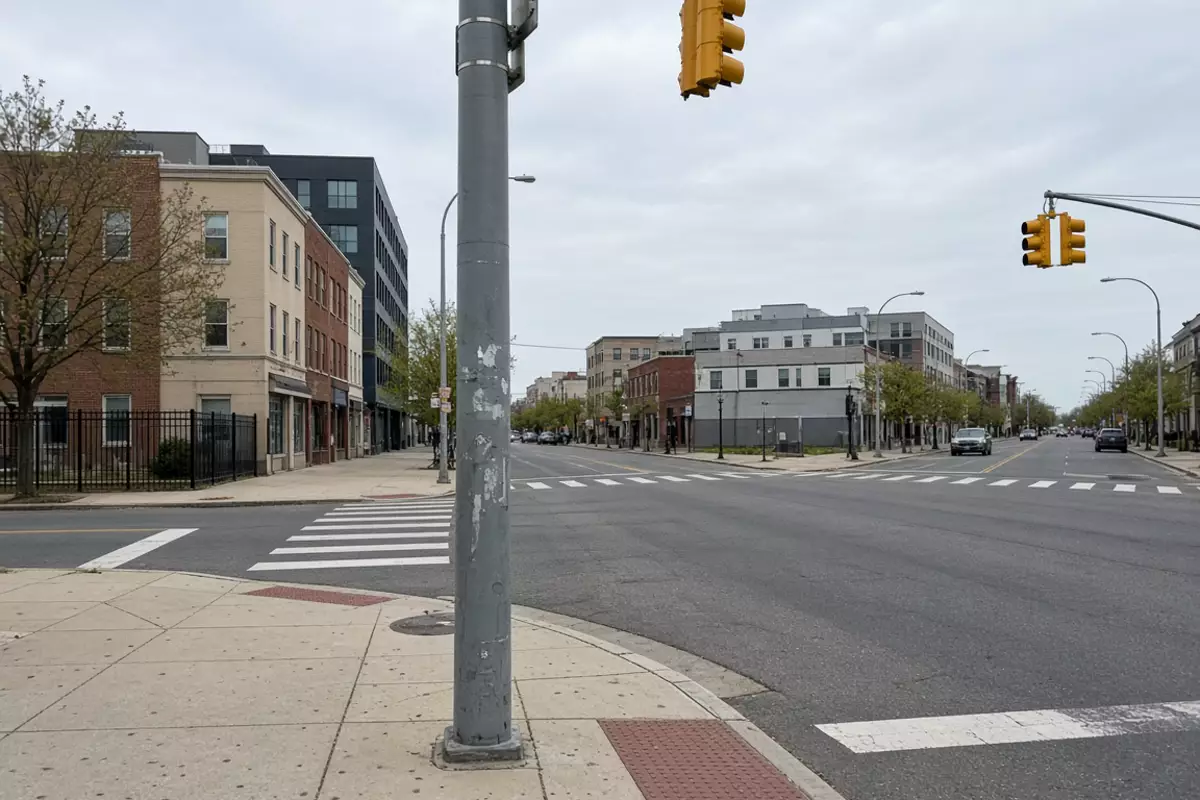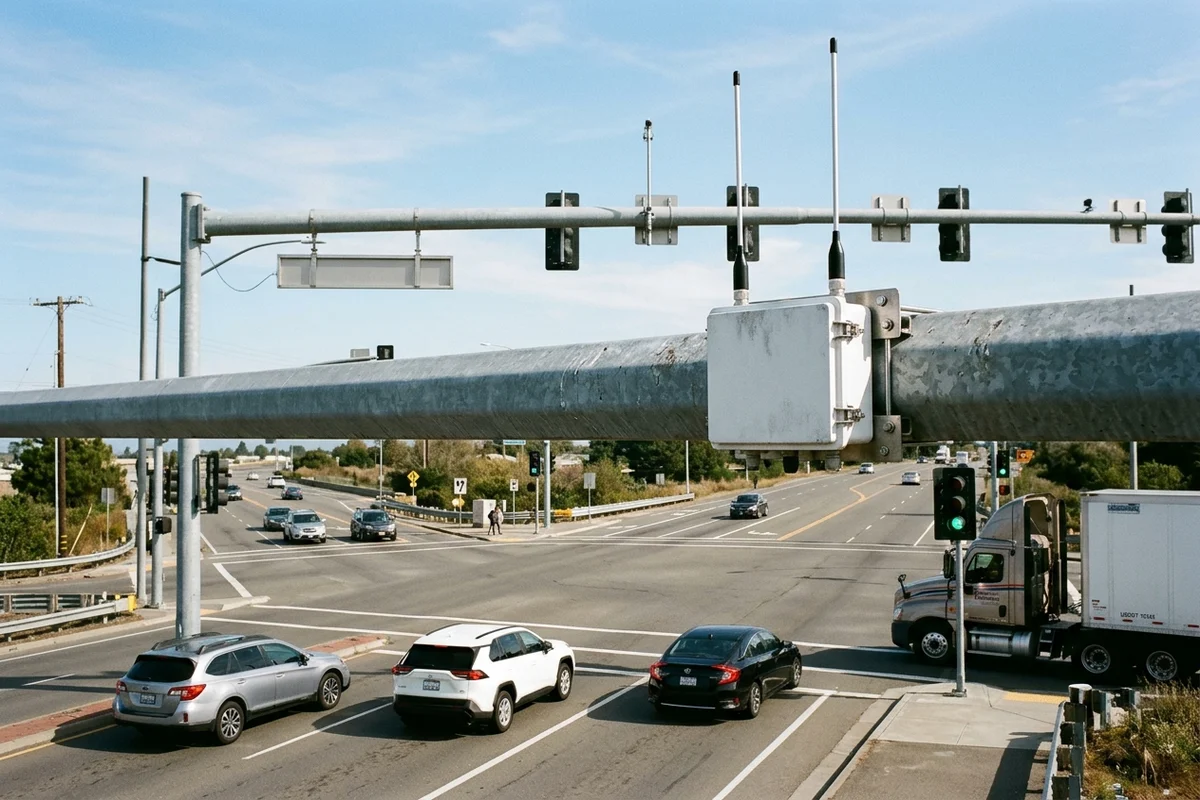
Cellular-V2X (C-V2X) is based on the 3GPP LTE family of standards while DSRC is based on the IEEE 802.11 family of standards, and C-V2X is incompatible with DSRC-based operations.
For the general scope of vehicle communication on this site, start with what V2X refers to and how V2V, V2I and V2N name separate paths within Connected Mobility. This guide compares the air interfaces, physical and MAC layer mechanisms, upper-layer stack mappings, and commercial RSU and OBU hardware specifications.
| Comparison dimension | Technical specification and operating scope |
|---|---|
| 3GPP C-V2X umbrella architecture | Cellular-V2X (C-V2X) is the umbrella term encapsulating all 3GPP V2X technologies, including both direct (PC5) and mobile network communications (Uu) |
| C-V2X device-to-device mode (V2V, V2I, V2P) | In device-to-device mode (V2V, V2I, V2P), C-V2X can operate without a SIM and without network assistance, using GNSS as its primary time synchronisation source |
| C-V2X network mode (V2N) | C-V2X supports V2N applications using existing cellular networks, delivering network assistance and commercial services requiring a Mobile Network Operator (MNO) |
| DSRC direct Wireless LAN mode | DSRC is a Wireless LAN (WLAN) based technology specified by IEEE 802.11p that transmits and receives data without passing via other infrastructures such as mobile networks |
| DSRC dense-traffic MAC contention | DSRC faces channel congestion in dense vehicular environments, with packet collisions due to CSMA/CA as the MAC protocol leading to high latency |
| C-V2X dense-traffic resource selection | In dense vehicular traffic, C-V2X senses available resources, sorts them, and picks the least congested resources over a semi persistent resource allocation methodology |
| 5.9 GHz radio link compatibility | There is an absence of interoperability at the radio link level between LTE-V2X (PC5) and 802.11p |
How C-V2X splits direct sidelink (PC5) and cellular network (Uu) paths
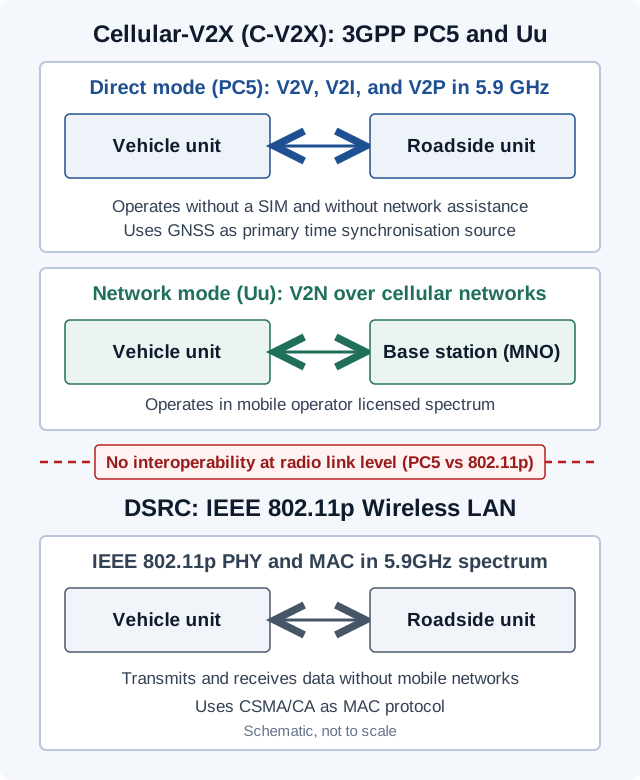
Takeaway: Cellular-V2X (C-V2X) is the umbrella term encapsulating all 3GPP V2X technologies, including both direct (PC5) and mobile network communications (Uu).
In C-V2X, direct safety communication (V2V, V2I, V2P) operates in ITS bands (e.g., 5.9 GHz), while Vehicle-to-Network (V2N) operates in the mobile operator’s licensed spectrum. In device-to-device mode (V2V, V2I, V2P), C-V2X can operate without a SIM and without network assistance, using GNSS as its primary time synchronisation source. C-V2X supports V2N applications using existing cellular networks, delivering network assistance and commercial services requiring a Mobile Network Operator (MNO).
This split also governs how links are verified and scheduled. V2N requires testing the operation of call connections between a vehicle and each base station, whereas V2V, V2I, and V2P do not require call connections. In C-V2X, Transmission mode 3 is when the network schedules resources, whereas Transmission mode 4 (TM4) is when vehicles autonomously select resources with no network involvement.
Across successive standard releases, the air interface evolved while maintaining backward compatibility for basic safety exchanges:
- 3GPP Release 14: LTE-V2X was completed in 3GPP Release 14 in 2017, including both direct and mobile network communications delivering basic safety use cases.
- 3GPP Release 15: 3GPP Release 15 incorporates Transmit Diversity and a 10 ms PDB (Packet Delay budget) for improved range and reliability.
- 3GPP Release 16: 5G-V2X was completed in 3GPP Release 16 in 2020, combining direct and mobile network communications to enable advanced and automated driving use cases.
- Inter-release compatibility: A Release 16 capable vehicle can communicate with a Release 14 car using the Release 14 air interface for BSM exchanges, and with Release 16 cars using the 5G NR C-V2X air interface.
PHY and MAC differences: IEEE 802.11p CSMA/CA vs 3GPP C-V2X resource allocation
Takeaway: DSRC is based on the IEEE 802.11p standard for its PHY and MAC layers and operates in the 5.9GHz spectrum.
DSRC is a Wireless LAN (WLAN) based technology specified by IEEE 802.11p that transmits and receives data without passing via other infrastructures such as mobile networks. Periodic basic safety messages (BSM) with PHY layer overheads and the full security certificate header typically measure around 300 bytes and are expected to be transmitted up to once every 100 ms.
When many vehicles broadcast periodic messages in the same corridor, the MAC and physical-layer designs behave differently:
- Channel access and contention: DSRC faces channel congestion in dense vehicular environments, with packet collisions due to CSMA/CA as the MAC protocol leading to high latency.
- Semi-persistent sensing in C-V2X: In dense vehicular traffic, C-V2X senses available resources, sorts them, and picks the least congested resources over a semi persistent resource allocation methodology.
- Pilot subcarrier spacing in IEEE 802.11p: In IEEE 802.11p, only four out of the 52 subcarriers are used for Pilots, so for 10 MHz operation in IEEE 802.11p, two adjacent subcarriers are 2.4 MHz away.
- High-speed Doppler estimation in C-V2X: At relative speeds of 500 Km/hr, C-V2X addresses large Doppler shift and frequency offset by introducing extra reference signal symbols for improved channel estimation.
Why shared upper-layer stacks do not make PC5 and 802.11p interoperable
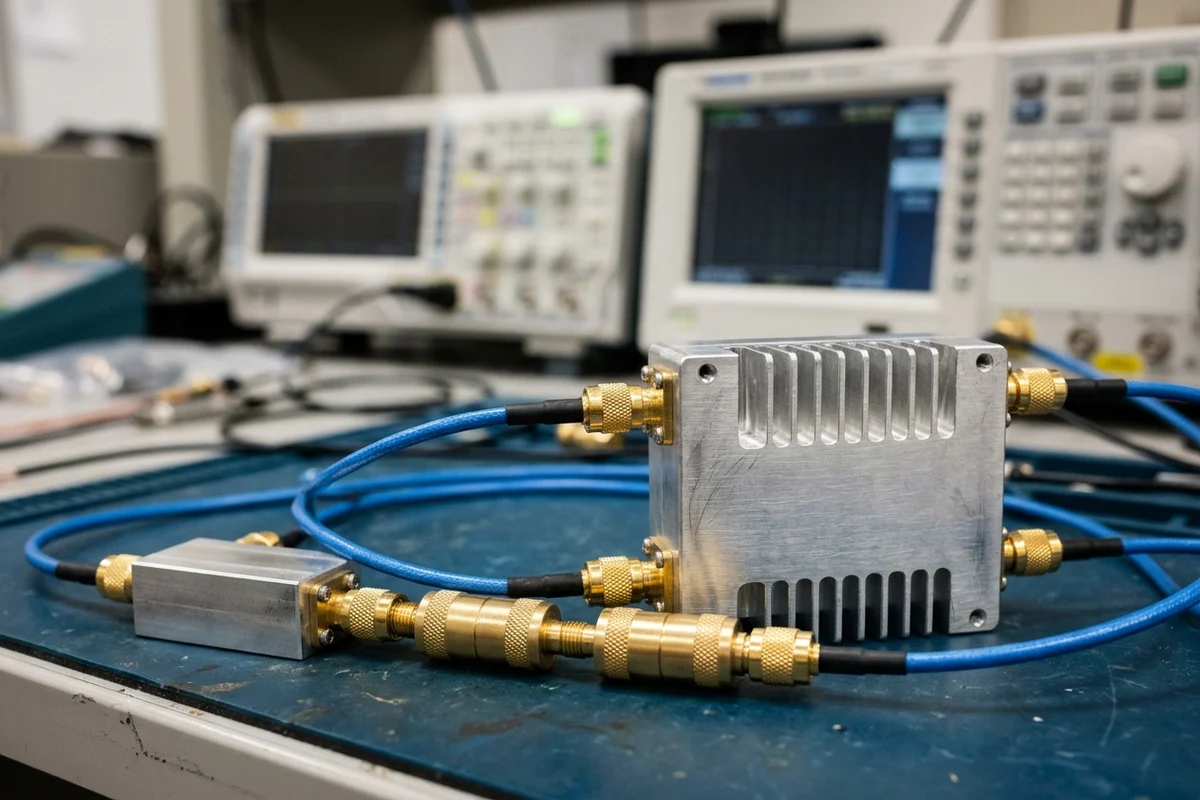
Takeaway: 3GPP LTE-V2X PC5 (LTE side-link) and IEEE 802.11p (DSRC or ITS-G5) both operate in the 5.9 GHz band for direct communications between road users. There is an absence of interoperability at the radio link level between LTE-V2X (PC5) and 802.11p.
C-V2X is based on the 3GPP LTE family of standards while DSRC is based on the IEEE 802.11 family of standards, and C-V2X is incompatible with DSRC-based operations. The FCC DSRC rules incorporated by reference the ASTM E2213-03 DSRC standard, and in 2010 IEEE adopted the 802.11p standard for wireless access in vehicular environments. In the 5.9 GHz band reserved for DSRC, the FCC proposed dedicating the upper 30 megahertz to ITS while repurposing the lower 45 megahertz for unlicensed operations.
- IEEE WAVE protocol stack layers: In the WAVE stack, upper-layer message sublayers are composed from the SAE International J2735 dictionary and J2945/1 performance requirements. In the WAVE stack, networking and transport layers are based on IEEE 1609.3, security services on IEEE 1609.2, and the MAC sublayer on IEEE 1609.4.
- ETSI GeoNetworking media separation: GeoNetworking can be executed over different short-range ITS access technologies such as ITS-G5 or C-V2X, with media-independent functionalities in ETSI TS 103 836-4-1. A Networking Services implementation using LTE-V2X and NR-V2X shall use access layer functionality for sidelink communication as defined in ETSI EN 303 798.
- ETSI GeoNetworking addressing and casting over PC5: For the GeoNetworking address MID field, the 24-bit Source or Destination Layer 2 ID (per ETSI TS 136 321 and ETSI TS 138 321) shall be used for Octets 2-4 and Octets 5-7 shall be set to zero. For broadcast in GeoNetworking, the Destination Layer 2 ID shall be set to all “1”s unless the facilities layer standard specifies otherwise, and Groupcast is only supported by NR-V2X.
- Multi-vendor sidelink conformance testing: The 4th ETSI C-V2X Plugtests event enabled On-Board-Units (OBUs), Roadside-Units (RSUs), and Public key infrastructures (PKIs) vendors to test direct communication using ETSI TC ITS Release 2 standards, and also explored ITS services over 5G NR Sidelink.
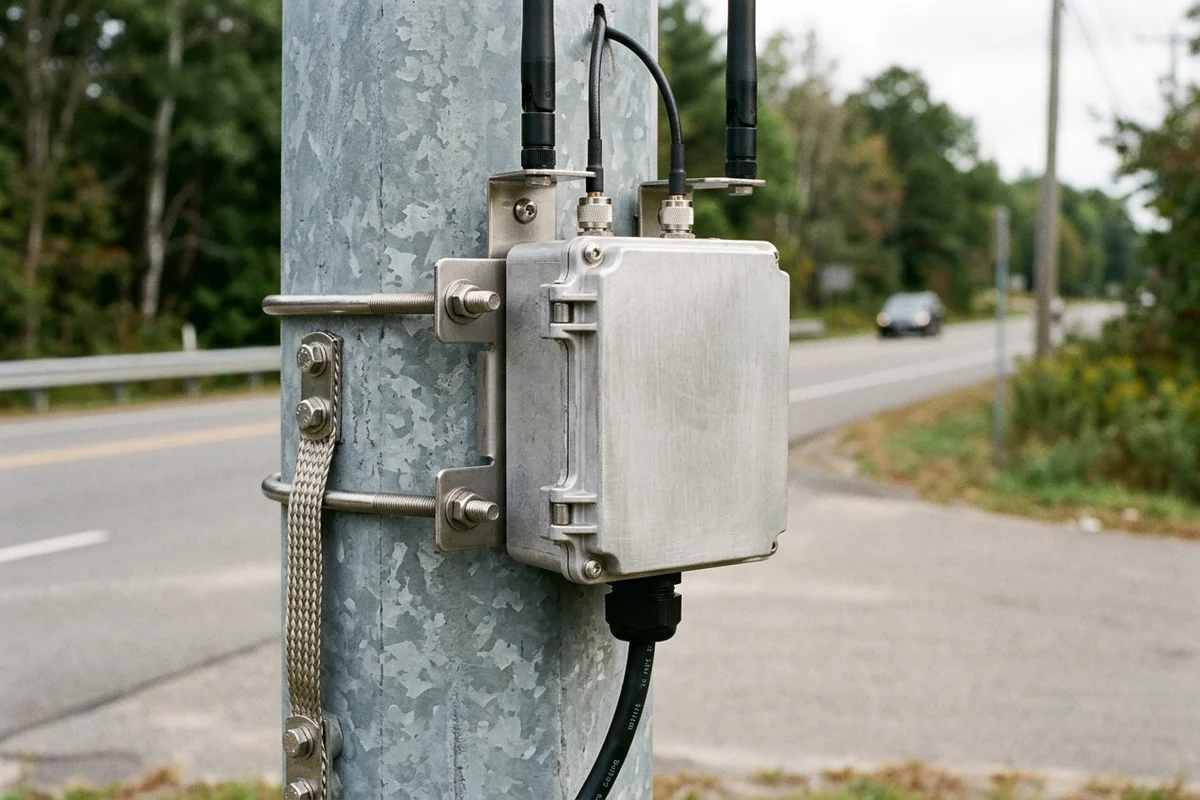
For historical context on how earlier roadside field trials described vehicle-to-infrastructure links, see how a vehicle-to-infrastructure path is described.
Roadside Unit (RSU) and On-Board Unit (OBU) hardware comparison
Takeaway: Kapsch RIS-9260 is a dual-mode 5.9GHz Roadside Unit (RSU) providing both IEEE 802.11p DSRC and 3GPP C-V2X (LTE-V2X) wireless communication for ETSI ITS G5 and IEEE WAVE standards.
Evaluating named hardware models shows how radio access support, frequency sub-bands, channel spacing, output power, and receiver sensitivity are specified per model:
| Device model and radio path | Supported radio standard and channel bandwidth | RF band, output power, sensitivity, and enclosure details |
|---|---|---|
| Kapsch RIS-9260 (DSRC radio) | IEEE 802.11p radio with 10MHz channel spacing | On the Kapsch RIS-9260, the DSRC (IEEE 802.11p) radio operates in the 5.850–5.925GHz frequency band with 10MHz channel spacing, max 20dBm output power, and typ -92dBm sensitivity at 6Mbps |
| Kapsch RIS-9260 (C-V2X radio) | 3GPP LTE-V2X Rel.14 with 10MHz / 20MHz PC5 sidelink | On the Kapsch RIS-9260, the C-V2X (3GPP LTE-V2X Rel.14) radio operates in the 5.895–5.925GHz band (LTE B47) with 10MHz / 20MHz PC5 sidelink, 20dBm output power (power class 3), and typ -95dBm sensitivity |
| Kapsch RIS-9360 (single-mode C-V2X RSU) | 3GPP LTE-V2X Rel.14 with 20MHz (/ 10MHz) PC5 sidelink | On the Kapsch RIS-9360 single-mode C-V2X RSU, the 3GPP LTE-V2X Rel.14 radio operates in the 5.895–5.925GHz band (LTE B47) with 20MHz (/ 10MHz) PC5 sidelink, 20dBm output power (power class 3), and typ -95dBm sensitivity |
| Kapsch CBX-9360 (C-V2X OBU) | 3GPP LTE-V2X Rel.14 radio with 20 (/10) MHz channel spacing and LTE-V2X PC5 sidelink | Kapsch CBX-9360 has a 3GPP LTE-V2X Rel.14 radio in the 5.850 to 5.925GHz band with 20 (/10) MHz channel spacing, LTE-V2X PC5 sidelink, and typ.-95dBm sensitivity |
| Cohda Wireless MK6 RSU | DSRC and C-V2X with 10 & 20 MHz bandwidth | Cohda Wireless MK6 RSU has POE+ 802.3at Class 4 power, -99dBm @ 3Mbps sensitivity, max Tx power of +22dBm for DSRC and +21.5dBm for C-V2X, 10 & 20 MHz bandwidth, and an IP67 enclosure |
| Cohda Wireless MK6 OBU | DSRC and C-V2X with 10 & 20 MHz bandwidth | Cohda Wireless MK6 OBU operates on 7-36 VDC power (<1mA at 12V backup), with -99dBm @ 3Mbps sensitivity, max Tx power of +22dBm for DSRC and +21.5dBm for C-V2X, and 10 & 20 MHz bandwidth |
| Yunex Traffic OBU2X | 1 x IEEE 802.11p / C-V2X (3GPP Rel.14/15) 5.9 GHz radio | The Yunex Traffic OBU2X technical details specify a 1 x IEEE 802.11p / C-V2X (3GPP Rel.14/15) 5.9 GHz radio and a flame-resistant plastic enclosure with protection class IP54 according to IEC 60529 |
When comparing these platforms for corridor procurement, verify the model-specific architecture and certification details stated in each supplier document:
- Kapsch RIS-9260 vs RIS-9360 RSU scope: Kapsch RIS-9260 is a dual-mode 5.9GHz Roadside Unit (RSU) providing both IEEE 802.11p DSRC and 3GPP C-V2X (LTE-V2X) wireless communication for ETSI ITS G5 and IEEE WAVE standards. Kapsch RIS-9260 meets the US DOT 4.1 RSU Specifications and has been certified by OmniAir for the US. By contrast, Kapsch RIS-9360 provides 3GPP C-V2X (LTE-V2X) wireless communication for IEEE WAVE standards, with a certification note specifying an exception for access layer C-V2X radio parameters.
- Kapsch CBX-9360 OBU environmental ratings: Kapsch CBX-9360 operates on a 12/24V DC vehicle power supply with an IP 31 enclosure across an operating temperature range of -40°C to 75°C.
- Cohda Wireless MK6 vs MK5 chipset and standard conformance: Cohda Wireless MK6 RSU is a dual V2X RSU equipped with DSRC (2x NXP RoadLink SAF5400 chipset), C-V2X (Qualcomm SA515 chipset supporting 3GPP R15, 5G), and Cellular 5G NR with 4G (LTE Cat 19) fallback. Cohda Wireless MK6 RSU lists V2X test standard conformance for IEEE 802.11-2012, IEEE 1609-2020, ETSI ES 202 663, SAE J2735-2020, SAE J3161/1, J3161/1A, J3161-2022, and T/CSAE-2021. Cohda Wireless MK6 OBU includes a 1x 3in1 C-V2X / DSRC / GNSS antenna connector and interfaces for Ethernet (IEEE802.3), Automotive Ethernet (100BASE-T1), USB 2.0, and CAN-FD up to 5Mbit/sec. Earlier Cohda Wireless MK5 OBU and RSU are 5th-generation units proven ready for DSRC large-scale field trials, aftermarket deployments, or reference designs.
- Yunex Traffic OBU2X hybrid operation: The Yunex Traffic OBU2X supports hybrid communication via DSRC/802.11p and LTE 4G, and supports V2X standards including CAM (R09), SREM, SSEM, SPATEM, MAPEM, DENM, and IVIM.
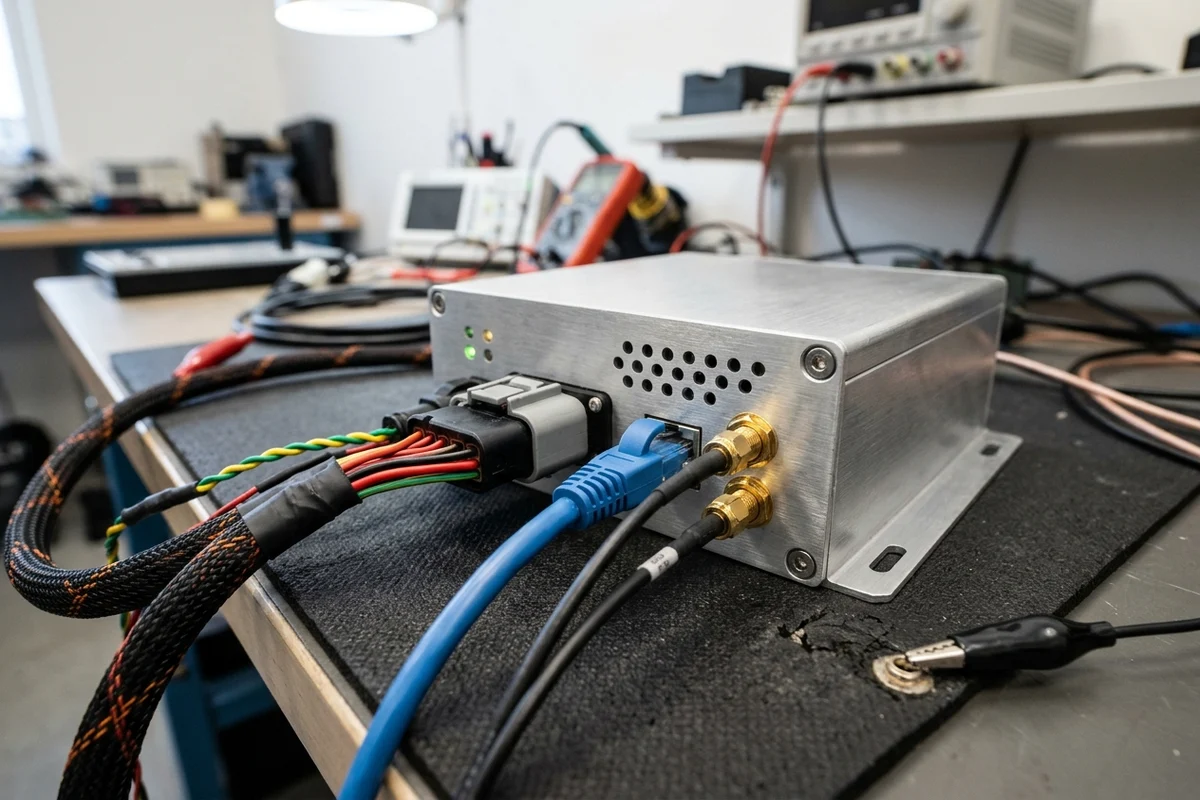
Corridor radio access and interoperability verification checklist
Use the verification items below to check air-interface alignment between roadside infrastructure and vehicle fleets before deployment:
| Verification item | Engineering requirement to confirm |
|---|---|
| Air-interface standard family | C-V2X is based on the 3GPP LTE family of standards while DSRC is based on the IEEE 802.11 family of standards, and C-V2X is incompatible with DSRC-based operations |
| C-V2X resource scheduling mode | In C-V2X, Transmission mode 3 is when the network schedules resources, whereas Transmission mode 4 (TM4) is when vehicles autonomously select resources with no network involvement |
| GNSS synchronization for direct mode | In device-to-device mode (V2V, V2I, V2P), C-V2X can operate without a SIM and without network assistance, using GNSS as its primary time synchronisation source |
| Call connection test boundary | V2N requires testing the operation of call connections between a vehicle and each base station, whereas V2V, V2I, and V2P do not require call connections |
| ETSI sidelink access layer mapping | A Networking Services implementation using LTE-V2X and NR-V2X shall use access layer functionality for sidelink communication as defined in ETSI EN 303 798 |
| Dual-mode RSU vs single-mode RSU selection | Kapsch RIS-9260 is a dual-mode 5.9GHz Roadside Unit (RSU) providing both IEEE 802.11p DSRC and 3GPP C-V2X (LTE-V2X) wireless communication for ETSI ITS G5 and IEEE WAVE standards |
Sources
- 5G Automotive Association (5GAA) — C-V2X Explained
- 5G Automotive Association (5GAA) — An Assessment of LTE-V2X (PC5) and 802.11p Direct Communications Technologies
- Anritsu — V2X (Vehicle-to-Everything) Test and Measurement Solutions
- Qualcomm Technologies — C-V2X and IEEE 802.11p Technical Introduction
- Federal Communications Commission (FCC) — Fact Sheet on the 5.9 GHz Band (DOC-360940A1)
- ETSI — TS 103 836-4-3 Intelligent Transport Systems GeoNetworking Media-Dependent Functionalities for LTE-V2X PC5
- ETSI — C-V2X Plugtests Event Overview
- Kapsch TrafficCom — RIS-9260 Roadside Unit DataSheet
- Kapsch TrafficCom — RIS-9360 C-V2X Roadside Unit DataSheet
- Kapsch TrafficCom — CBX-9360 C-V2X On-Board Unit DataSheet
- Cohda Wireless — MK6 RSU Product Brief
- Cohda Wireless — MK6 OBU Product Brief
- Cohda Wireless — V2X Stack and Applications Product Brief
- Yunex Traffic — OBU2X Onboard Unit Datasheet