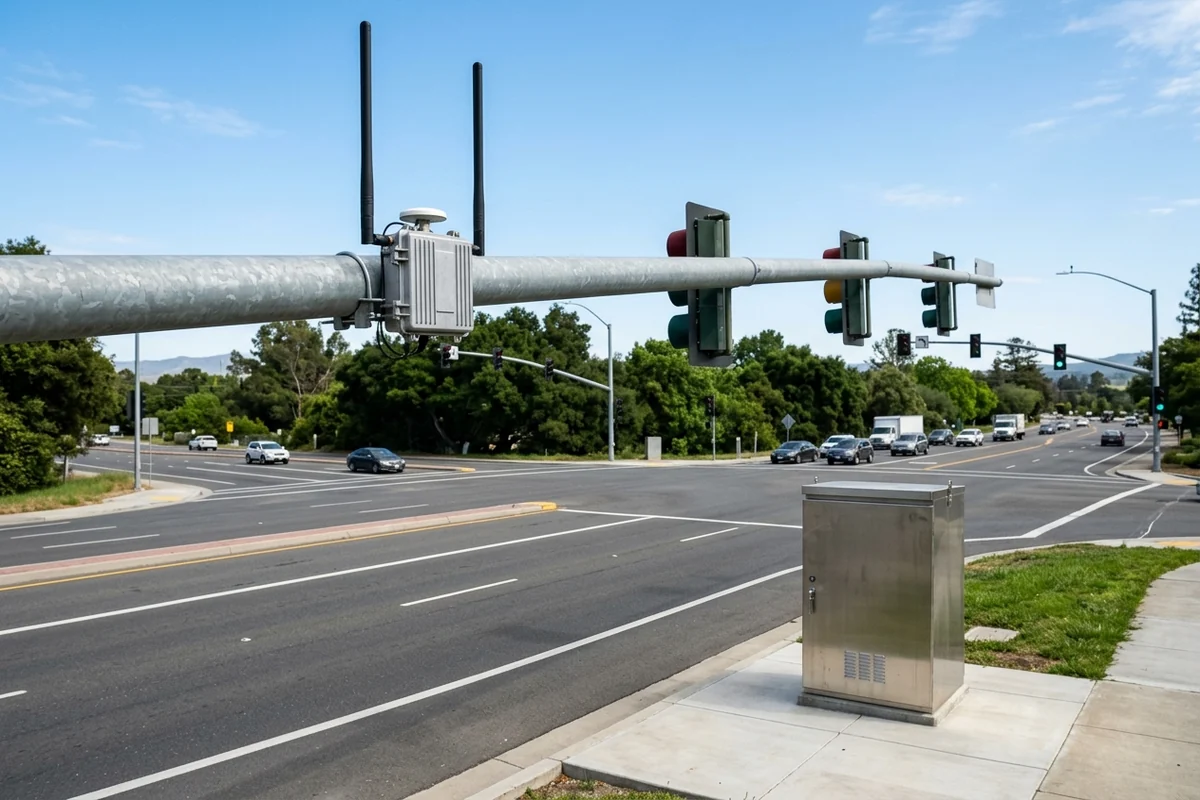
To support V2I applications, DSRC must be integrated with existing traffic equipment, such as Signal Controllers and backhaul connections to Traffic Management Centers (TMCs). A carrier-grade RSU is defined as an RSU in which both hardware and software components operate un-attended in harsh outdoor environments for extended periods (typical MTBF of 100,000 hours).
Related coverage on this site examines vehicle-to-everything communication, vehicle-to-vehicle, infrastructure, and network paths, direct sidelink and dedicated short-range radio access, and roadside infrastructure communication architecture across Connected Mobility.
| Standard or architectural dimension | Documented requirement and scope |
|---|---|
| V2I roadside integration | To support V2I applications, DSRC must be integrated with existing traffic equipment, such as Signal Controllers and backhaul connections to Traffic Management Centers (TMCs) |
| Carrier-grade RSU reliability | A carrier-grade RSU is defined as an RSU in which both hardware and software components operate un-attended in harsh outdoor environments for extended periods (typical MTBF of 100,000 hours) |
| CTI 4001 C-ITS baseline | CTI 4001 establishes a non-proprietary, communications-agnostic, industry consensus Roadside Unit (RSU) Standard for a Cooperative Intelligent Transportation Systems (C-ITS) environment |
| CTI 4001 publication timeline | CTI 4001 v01.00 Roadside Unit (RSU) Standard was published on 11/11/2021, and CTI 4001 v01.01 Roadside Unit (RSU) Standard Amendment was published on 9/16/2022 |
| Legacy specification replacement | CTI 4001 is communications-agnostic and supersedes USDOT’s Dedicated Short-Range Communications Roadside Unit Specifications v4.1 |
| NTCIP 1218 v01 logical interface | NTCIP 1218 v01 specifies the logical interface between an RSU and controlling management stations using SNMP object-type format as defined in RFC 1212, specifically SNMPv3 format (published September 2020) |
| NTCIP 1218 v01A amendment | The NTCIP 1218 v01A Amendment was published in 2024 to support LTE-V2X communications and respond to guidance in CTI 4501, CTI 4001, and NTCIP 1202 v03B |
Radio coverage, mast-arm placement, and GNSS timing requirements
Takeaway: When deploying RSUs, factors to consider include radio line of sight for optimal placement of antennas, distance limitations between the RSU and Roadside Cabinet Electronics (RSCE) due to PoE connections, and GNSS satellite visibility.
In Figure 3 of the RSU standard, an RSU may be mounted on a pole or a mast arm with the antennas mounted separately on a mast arm when weight or wind are concerns for a particular mast arm. The RSU shall weigh less than 6.8 kilograms (15.0 pounds) and have a surface area of less than 5,452 square centimeters (845 square inches), excluding antennas and brackets. If the RSU supports interchangeable antennas (including connector port and cabling), then the RSU shall use a Type N connector for the V2X RF antenna, with an impedance of 50 ohms.
RSU transmit power should account for antenna gain and cable loss factors; for applications such as traffic signal priority where a range of 500 meters or more is desired, the sum of antenna gain in dBi and transmit power in dB cannot exceed the FCC EIRP limit. Transmit power out of the V2X radio subsystem measured at the antenna connector of the subsystem housing shall be within 2 dB of its setting over 95 percent of measurements at each setting within the range 0 to 20 dBm (with a note that C-V2X transmitters may be capable of up to 23 dBm).
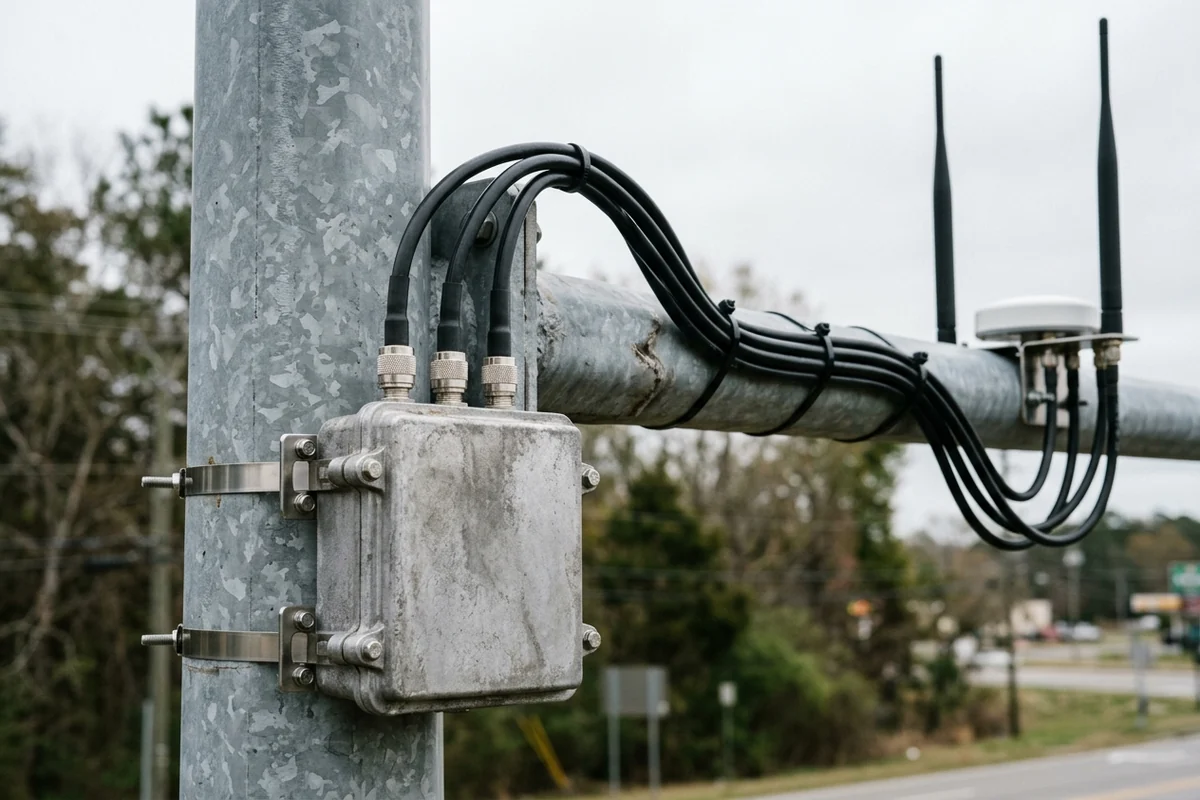
CTI 4001 establishes a non-proprietary, communications-agnostic, industry consensus Roadside Unit (RSU) Standard for a Cooperative Intelligent Transportation Systems (C-ITS) environment.
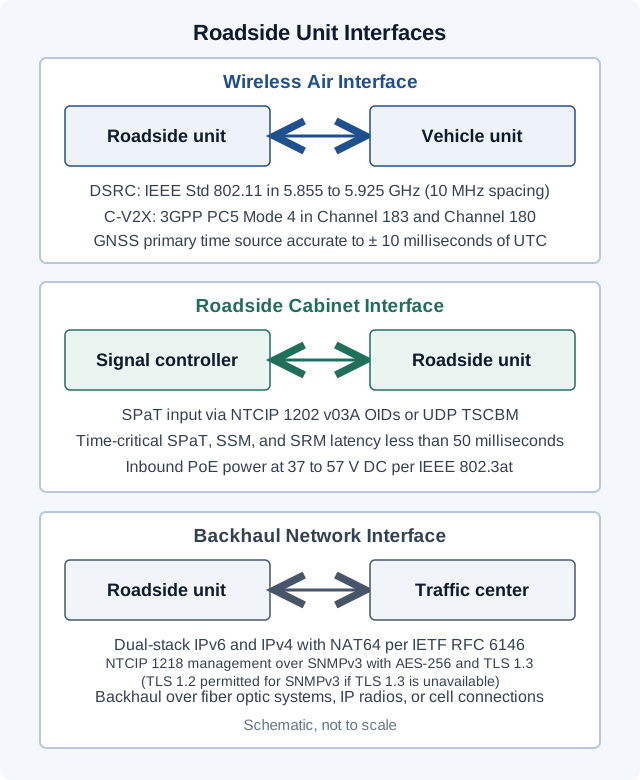
- DSRC channel allocation: For DSRC, the RSU shall implement IEEE Std 802.11 in the 5.855 to 5.925 GHz band on channels 172, 174, 176, 178, 180, 182, and 184 with 10 MHz channel spacing.
- DSRC receiver sensitivity: The packet error rate of the DSRC radio subsystem shall be 10 percent or less when the PSDU length is 400 octets and the input level is -92 dBm at 6 Mbps (QPSK with 1/2 rate coding) at room temperature (21 degrees C ± 5 degrees C).
- C-V2X PC5 sidelink channels: For C-V2X, the RSU shall implement 3GPP PC5 Mode 4 (V2X Sidelink) in the 5.905 to 5.925 GHz band (Channel 183) and in the 5.895 to 5.905 GHz band (Channel 180).
- C-V2X receiver sensitivity: The packet error rate of the C-V2X radio subsystem shall be 10 percent or less when the payload length is 367 octets and the input level is -94 dBm using MCS 11 at room temperature (21 degrees C +/- 5 degrees C) for a single antenna configuration using HARQ (one retransmission).
- Sectorized RF coverage logging: NTCIP 1218 table rsuCommRangeTable logs effective RF reception coverage around the RSU using sectors that each represent a 22.5-degree slice starting from North, storing farthest and average farthest distances over rolling 1-, 5-, and 15-minute periods.
- Primary GNSS and secondary NTP timekeeping: The RSU shall use a GNSS receiver as its primary time source with system clock time output accurate to ± 10 milliseconds of the UTC reference, and use Network Time Protocol (NTP) as a secondary time source if it has not received valid time from the GNSS after 120 seconds.
- WGS-84 location reporting and satellite watchdog: The RSU shall report its position as latitude, longitude, elevation, and estimated error based on the WGS-84 coordinate system, and write a CRITICAL entry to the System Log if it is not able to acquire a minimum of four satellites within 120 seconds after entering the Operate state.
Traffic signal controller interface: Store and Repeat, Immediate Forward, and SPaT processing
Takeaway: The RSU transmits Application Layer PDUs formatted in accordance with SAE J2735 using one of two mechanisms: Store and Repeat (downloaded from a back office service and stored on the RSU) or Immediate Forward (transmitted as they are sent to the RSU).
The MIB object maxRsuMsgRepeat (OID 1.3.6.1.4.1.1206.4.2.18.3.1) has SYNTAX Integer32 (1..255) messages and indicates the maximum number of Store and Repeat messages (rows in rsuMsgRepeatStatusTable) the Roadside Unit supports. The MIB object maxRsuIFMs (OID 1.3.6.1.4.1.1206.4.2.18.4.1) has SYNTAX Integer32 (1..255) messages and indicates the maximum number of Immediate Forward messages (rows in rsuIFMStatusTable) the Roadside Unit supports.
The MIB object rsuMsgRepeatPayload2 has SYNTAX OCTET STRING (SIZE(0..4214)) derived from SAE J3161; for SAE J2735 messages, the size of the Signed WSMP message including the WSMP header and 1 Byte non-IP LLC byte must be 4214 or less, and packets 4215 or larger should be dropped by the RSU. The RSU shall periodically repeat stored messages to the V2X interface within 5 milliseconds of the expected transmission time, as specified by the transmission interval for that message, including security credentials and any encryption processing.
NTCIP 1218 v01 specifies the logical interface between an RSU and controlling management stations using SNMP object-type format as defined in RFC 1212, specifically SNMPv3 format (published September 2020). The NTCIP 1218 v01A Amendment was published in 2024 to support LTE-V2X communications and respond to guidance in CTI 4501, CTI 4001, and NTCIP 1202 v03B.
- Time-critical forwarding latency budget: For time-critical messages—SPaT (PSID 0x82 / 0p82), SSM status (PSID 0x20-40-95 / 0pE0-00-00-15), and SRM request (PSID 0x20-40-96 / 0pE0-00-00-16)—latency between reception on one interface and transmission on the other interface on the same RSU shall be less than 50 milliseconds (versus less than 1 second for non-time critical messages).
- SPaT encoding and signing pipeline: SPaT processing uses interfaces defined in NTCIP 1202 v03A or TSCBM to send SPaT information from the RSCE/traffic signal controller to the RSU, which formats it into a SAE J2735_202007 SPaT message with UPER encoding, signs it per IEEE Std 1609.2 for PSID 0x82 (0p80-02), and transmits it using IEEE Std 1609.3 WSMP.
- NTCIP 1202 v03A OID interface and heartbeat timeout: For the NTCIP 1202 SPaT interface, the RSU shall implement at a minimum the NTCIP 1202 v03A OIDs spatStatus (7.2.1), signalStatusBlock (7.2.8), and movementManeuverStatusBlock (7.2.9), and set the noValidSPATisAvailableAtThisTime bit if no ascCurrentTick (5.17.6) heartbeat has been received within the last 200 milliseconds.
- TSCBM UDP broadcast interface and timeout: For the TSCBM SPaT interface, the RSU listens on a configurable UDP port for Traffic Signal Controller Broadcast Messages (TSCBM) per NTCIP 1202 v03A Section E.1.10 and NEMA TS 10 Section 5.5.1 (populating IntersectionStatusObject from byte 232 and MovementState from bytes 2–231), and sets the noValidSPATisAvailableAtThisTime bit if no TSCBM has been received within the last 200 milliseconds.
Backhaul architecture, cabinet PoE+ surge isolation, and deployment costs
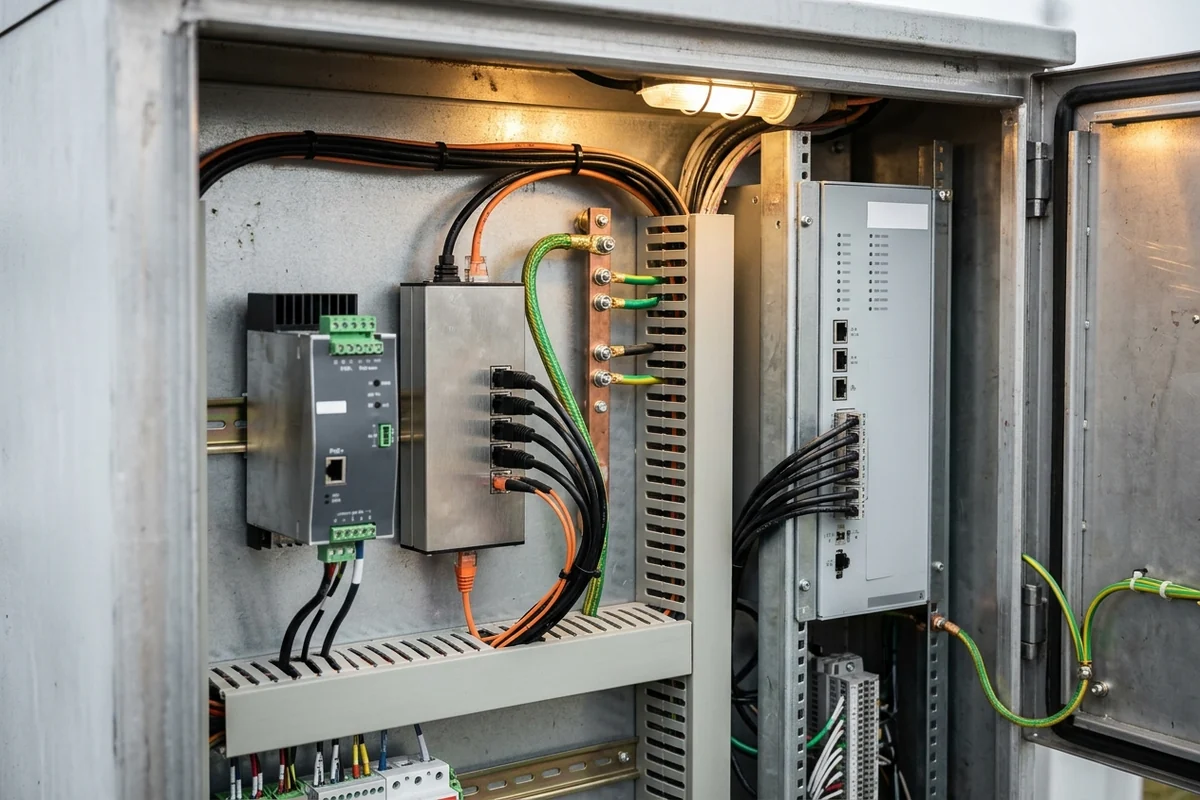
Takeaway: The roadside unit SHALL have a nominal operating voltage between 37 and 57 V DC and support inbound power through a single designated Ethernet port by Power-over-Ethernet (PoE) in compliance with IEEE 802.3at.
The RSU shall have a minimum transient suppression of 5KA 8/20μs that is terminated to earth ground (which may be met by adding an external surge protection device to the RSU’s PoE+ Ethernet connection), and the PoE+ power source shall be isolated from other 48 Vdc used in the cabinet. The RSU shall provide a minimum of 1x100 Base-T Ethernet (8P8C modular jack) port conformant with IEEE Std 802.3 including IPv4 and IPv6, and use an external 8P8C modular jack CAT-5e connector with 13/16“ - 28 UN screwed-in threading conforming to a minimum Outdoor IP67 rating. Under USDOT RSU Specifications v4.1, the roadside unit SHALL function within the ambient temperature range of -34 degrees C (-30 degrees F) to +74 degrees C (+165 degrees F) per NEMA TS 2-2003 v02.06, and under ambient temperature changes up to 17 degrees C (30 degrees F) per hour.
CTI 4001 is communications-agnostic and supersedes USDOT’s Dedicated Short-Range Communications Roadside Unit Specifications v4.1.
- Dual-stack IPv4/IPv6 and NAT64 translation: The RSU shall provide an Ethernet interface that can be configured on both IPv6 and IPv4 networks, including implementation of NAT64 as defined in IETF RFC 6146 to support IPv6 over the V2X Interface and IPv4 on the Network Interface.
- TLS 1.3 and TLS 1.2 session security: When setting up a TLS connection to another field device or a backend server, the RSU shall use TLS 1.3 (IETF RFC 8446), with exceptions permitting any security protocol supported by the SCMS and permitting TLS 1.2 (IETF RTC 5246) to protect SNMPv3 connections if SNMPv3 over TLS 1.3 is unavailable.
- SNMPv3 USM, TSM, and AES-256 confidentiality: The RSU shall protect management data by applying confidentiality services using the User-based Security Model (USM) for SNMPv3 (IETF RFC 3414, IETF RFC 5590), Transport Security Model (TSM) for SNMPv3 (IETF RFC 5591), Advanced Encryption Standard 256-bit (AES-256) keys (NIST FIPS PUB 197), and Transport Layer Security (TLS) Protocol (IETF RFC 6353).
- Regional ITS SNMPv3/TLS architecture profile: The US: NTCIP Roadside Unit - SNMPv3/TLS solution combines NTCIP 1218 RSU objects, CTI 4001, CTI 4501, NTCIP 1201 Global Objects, ISO 15784-2, and SNMPv3 over TLS per IETF RFC 6353 and IETF RFC 9456 over IPv4 or IPv6.
- Ready intersection deployment cost benchmark: For an intersection that is ‘ready’ for RSU deployment (signal cabinet has capacity and controller can support SPaT message development), estimated deployment costs are $7,000 to $15,000 per intersection (including MAP message development, FCC site registration, and security credentials), or as much as $50,000 when some states require a separate full planning/engineering/procurement process with marked milestones apart from federal requirements such as NEPA.
- Non-ready intersection upgrades and backhaul transport: For an intersection that is not ‘ready’ for RSU deployment, additional costs include $20,000 to $25,000 for a new cabinet, signal controller, and other features, and $20,000 to $40,000 for non-intrusive detection systems (such as radar); these estimates exclude backhaul costs (fiber optic systems, IP radios, or cell connections), which are required for RTCM position correction data and updated security certificates.
Commercial Roadside Unit (RSU) hardware comparison
Takeaway: The Kapsch RIS-9260 V2X Roadside Unit supports up to three 5.9GHz radio channels (two IEEE 802.11p and one C-V2X 3GPP Rel.14) activated by configuration, with 2 + 2 x 5.9GHz Antenna 50 Ohm N female connectors and 1 + 1 x GPS N female connectors.
CTI 4001 v01.00 Roadside Unit (RSU) Standard was published on 11/11/2021, and CTI 4001 v01.01 Roadside Unit (RSU) Standard Amendment was published on 9/16/2022.
| Device model | External interfaces, power, and cellular backhaul options | Hardware security, RF, and enclosure specifications |
|---|---|---|
| Kapsch RIS-9260 | On the Kapsch RIS-9260 RSU, external interfaces and power include 1 x GBit Ethernet (1 x PoE feed-in), PoE 802.3at-2009 (< 25W max) or 24V / 48V DC power supply, Multi GNSS (GPS, GLONASS, Galileo, BeiDou), and optional 3 x GPIO in, 3 x GPIO out | The Kapsch RIS-9260 RSU includes a Hardware Security Module (ECC) that is FIPS 140-2 level 3 compliant and CC EAL4+, an IP67 / NEMA Type 4X aluminium die-cast enclosure (Dimension: 290 x 200 x 78 mm, Weight: approx. 3kg), an operating temperature range of -40°C to +74°C, and MTBF >100.000 hours |
| Kapsch RIS-9360 | On the Kapsch RIS-9360 single-mode 5.9GHz C-V2X (3GPP LTE-V2X Rel.14) RSU, external interfaces are 2 x 5.9GHz Antenna 50Ohm N female, 1 x GBit Ethernet (1 x PoE feed-in, PoE 802.3at-2009 < 25W max or 24V / 48V DC), and 1 x GPS N female, while Configuration options include a Cellular modem module (3G/LTE), BT / WiFi module, and 3 x GPIO in, 3 x GPIO out | Single-mode 5.9GHz C-V2X (3GPP LTE-V2X Rel.14) RSU with 2 x 5.9GHz Antenna 50Ohm N female and 1 x GPS N female connectors |
| Cohda Wireless MK6 RSU | On the Cohda Wireless MK6 RSU, connectors comprise 2 x C-V2X, 2 x DSRC, 2 x LTE, 2 x Wi-Fi/BT, and 1 x GNSS antenna ports, 1 x Ethernet (IEEE802.3, 10/100/1000 Mbps Ethernet PoE+), and 1 x M12 ETH PoE+ power connector (POE+ 802.3at Class 4, Mode A and Mode B) | The Cohda Wireless MK6 RSU features an NXP i.MX 8 CPU (8544 DMIPS operating at 800MHz), -99dBm @ 3Mbps receiver sensitivity, max Tx power of +22dBm for DSRC and +21.5dBm for C-V2X, Advanced GNSS with RTK capability, SXF1800 FIPS 140-2 level 3 / CC EAL4+ security, and an IP67 enclosure (293mm x 233mm x 104mm, -40°C to + 74°C) |
| Commsignia ITS-RS4 | On the Commsignia ITS-RS4 RSU, interfaces include 10/100/1000 Mbps Ethernet PoE, 8-32 VDC / PoE power supply with optional 10s Store & Shutdown backup power, 3G / LTE (MiMo) cellular in Mini PCIe slot #2 only, antenna connectors (2 x V2X, 2 x WiFi, 2 x LTE/3G, 1 x GNSS), and data connectors (1 x ETH, 2 x USB, 1 x CAN, 1 x OBD-II) | The Commsignia ITS-RS4 RSU includes a Hardware Security Module (HSM) SLI97 (EAL6+ certified, > 2000 ECDSA verifications, < 50 usec signing delay) and a NEMA4X - IP67 vibration-proof waterproof outdoor enclosure that is pole and wall mountable |
| Yunex Traffic RSU2X | The Yunex Traffic RSU2X roadside unit communicates via WiFi 802.11p and LTE-V2x in the 5.9 GHz radio band, features a dual-core CPU in a weatherproof housing (stand-alone or integrated with a traffic control unit), and along with OBU2X is certified according to EU Trust Level 1 under the European Certificate Policy (EU CP) | Weatherproof housing for stand-alone or traffic-control-unit-integrated mounting, certified according to EU Trust Level 1 under the European Certificate Policy (EU CP) |
A carrier-grade RSU is defined as an RSU in which both hardware and software components operate un-attended in harsh outdoor environments for extended periods (typical MTBF of 100,000 hours).
- Kapsch RIS-9260 vs RIS-9360 configuration: The Kapsch RIS-9260 V2X Roadside Unit supports up to three 5.9GHz radio channels (two IEEE 802.11p and one C-V2X 3GPP Rel.14) activated by configuration, with 2 + 2 x 5.9GHz Antenna 50 Ohm N female connectors and 1 + 1 x GPS N female connectors. On the Kapsch RIS-9360 single-mode 5.9GHz C-V2X (3GPP LTE-V2X Rel.14) RSU, external interfaces are 2 x 5.9GHz Antenna 50Ohm N female, 1 x GBit Ethernet (1 x PoE feed-in, PoE 802.3at-2009 < 25W max or 24V / 48V DC), and 1 x GPS N female, while Configuration options include a Cellular modem module (3G/LTE), BT / WiFi module, and 3 x GPIO in, 3 x GPIO out.
- Cohda Wireless MK6 RSU wireless and cellular integration: Cohda Wireless MK6 RSU is a dual V2X RSU equipped with DSRC (2x NXP RoadLink SAF5400 chipset), C-V2X (Qualcomm SA515 chipset supporting 3GPP R15, 5G), Cellular 5G NR with fallback support for 4G (LTE Cat 19)/3G/2G, Wi-Fi 802.11 a/b/g/n/ac, and Bluetooth v5.1.
- Commsignia ITS-RS4 compute, radio variants, and TMC interfaces: Commsignia ITS-RS4 Roadside Unit is powered by an NXP i.MX 6 quadcore 792 MHz CPU with 2 GB DDR3 SDRAM and 4 GB eMMc, is available with Autotalks Secton, NXP TEF5100 & SAF5100, Marvell 88W8987PA, or Qualcomm 9150 V2X radio variants, and supports TMC interfaces including DATEX II and NTCIP.
- Yunex Traffic RSU2X dual-core platform: The Yunex Traffic RSU2X roadside unit communicates via WiFi 802.11p and LTE-V2x in the 5.9 GHz radio band, features a dual-core CPU in a weatherproof housing (stand-alone or integrated with a traffic control unit), and along with OBU2X is certified according to EU Trust Level 1 under the European Certificate Policy (EU CP).
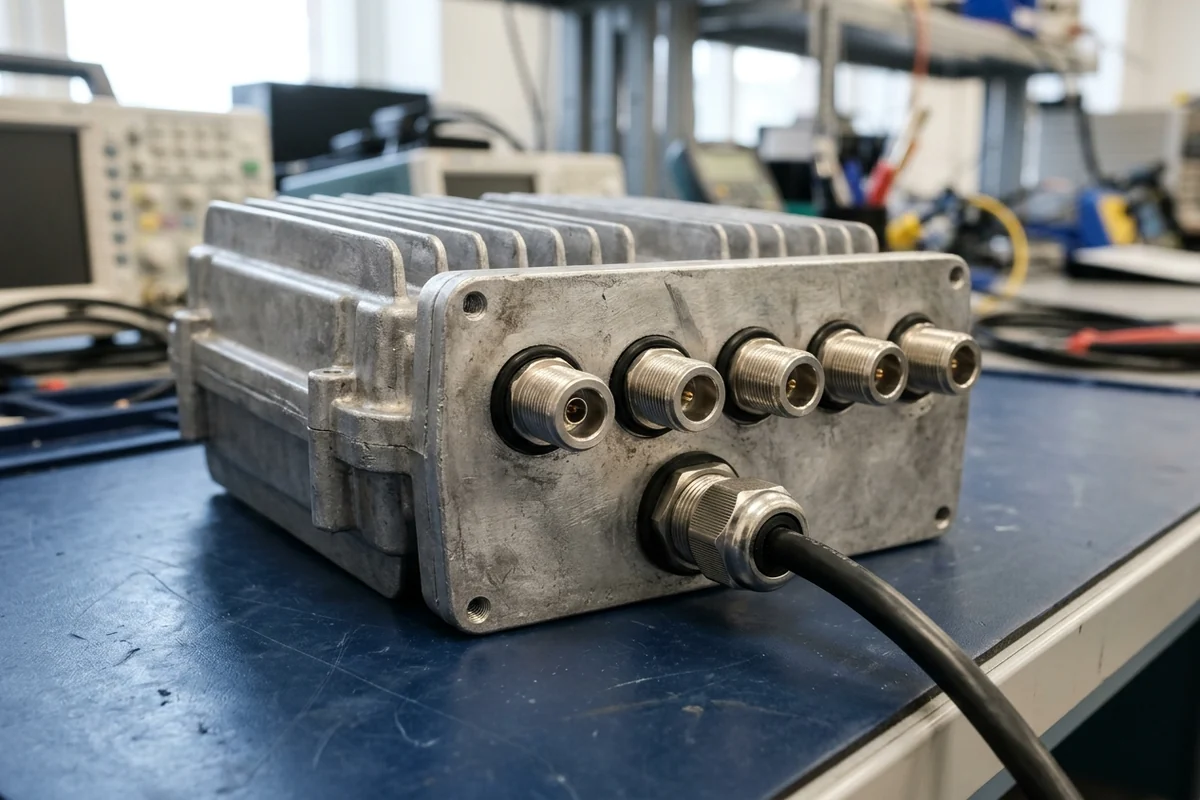
RSU field deployment and integration verification checklist
Takeaway: When deploying RSUs, factors to consider include radio line of sight for optimal placement of antennas, distance limitations between the RSU and Roadside Cabinet Electronics (RSCE) due to PoE connections, and GNSS satellite visibility.
| Verification item | Engineering requirement to confirm |
|---|---|
| Enclosure mass and wind-load area | The RSU shall weigh less than 6.8 kilograms (15.0 pounds) and have a surface area of less than 5,452 square centimeters (845 square inches), excluding antennas and brackets |
| GNSS primary clock and NTP fallback | The RSU shall use a GNSS receiver as its primary time source with system clock time output accurate to ± 10 milliseconds of the UTC reference, and use Network Time Protocol (NTP) as a secondary time source if it has not received valid time from the GNSS after 120 seconds |
| Cross-interface time-critical latency | For time-critical messages—SPaT (PSID 0x82 / 0p82), SSM status (PSID 0x20-40-95 / 0pE0-00-00-15), and SRM request (PSID 0x20-40-96 / 0pE0-00-00-16)—latency between reception on one interface and transmission on the other interface on the same RSU shall be less than 50 milliseconds (versus less than 1 second for non-time critical messages) |
| NTCIP 1202 SPaT OIDs and 200 ms watchdog | For the NTCIP 1202 SPaT interface, the RSU shall implement at a minimum the NTCIP 1202 v03A OIDs spatStatus (7.2.1), signalStatusBlock (7.2.8), and movementManeuverStatusBlock (7.2.9), and set the noValidSPATisAvailableAtThisTime bit if no ascCurrentTick (5.17.6) heartbeat has been received within the last 200 milliseconds |
| Cabinet PoE+ surge suppression and isolation | The RSU shall have a minimum transient suppression of 5KA 8/20μs that is terminated to earth ground (which may be met by adding an external surge protection device to the RSU’s PoE+ Ethernet connection), and the PoE+ power source shall be isolated from other 48 Vdc used in the cabinet |
| Dual-stack IPv4/IPv6 and NAT64 translation | The RSU shall provide an Ethernet interface that can be configured on both IPv6 and IPv4 networks, including implementation of NAT64 as defined in IETF RFC 6146 to support IPv6 over the V2X Interface and IPv4 on the Network Interface |
Sources
- U.S. Department of Transportation (FHWA) — DSRC Roadside Unit (RSU) Specifications Document v4.1
- U.S. DOT Architecture Reference for Cooperative and Intelligent Transportation (ARC-IT) — CTI 4001 Roadside Unit Standard Profile
- Institute of Transportation Engineers (ITE) — Roadside Unit (RSU) Standardization
- ITS New York / ConSysTec — Implementing CTI 4001 and NTCIP 1218 for Roadside Units
- NTCIP Joint Committee (AASHTO / ITE / NEMA) — Roadside Unit (RSU) Standard Overview
- AASHTO / ITE / NEMA — NTCIP 1218 v01A Object Definitions for Roadside Units (RSUs)
- AASHTO / ITE / NEMA — CTI 4001 v01.01 Roadside Unit (RSU) Standard (Amended)
- Florida Department of Transportation (FDOT) — Regional ITS Architecture: US: NTCIP Roadside Unit - SNMPv3/TLS
- Intelligent Transportation Society of America (ITS America) — National Connected Vehicle Roadside Unit Deployment Plan
- Kapsch TrafficCom — RIS-9260 V2X Roadside ITS Station DataSheet
- Kapsch TrafficCom — RIS-9360 C-V2X Roadside ITS Station DataSheet
- Cohda Wireless — MK6 RSU Product Brief
- Commsignia — ITS-RS4 Roadside Unit Product Brief
- Yunex Traffic — RSU2X Roadside Unit and OBU2X Onboard Unit Portfolio