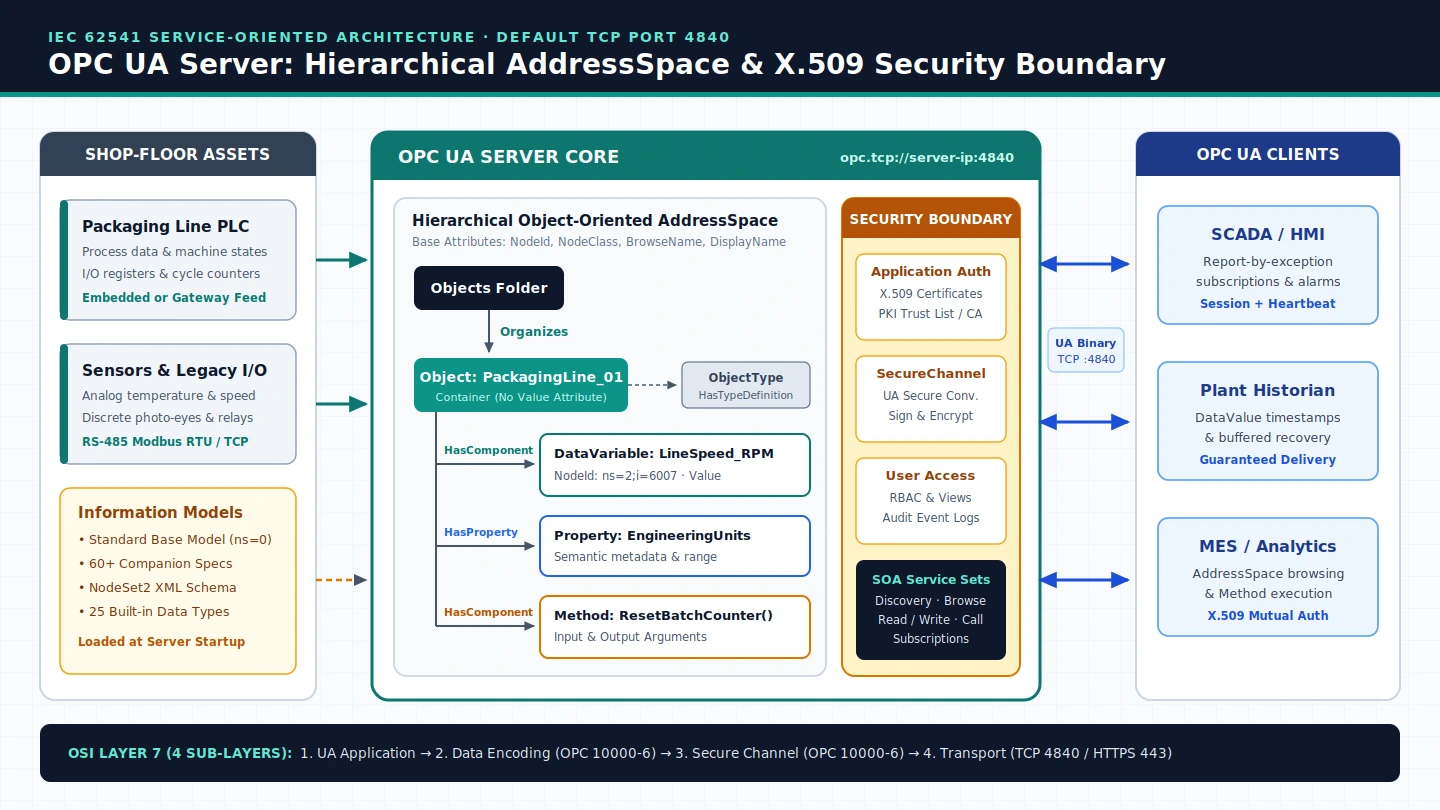
An OPC UA server (IEC 62541) is a platform-independent industrial service provider that models machine variables, callable methods, and semantic metadata inside a hierarchical AddressSpace while authenticating clients through X.509 certificates over default TCP port 4840. Deploy embedded controller servers for low client fan-out, and move multi-client polling onto an external aggregating gateway to protect controller responsiveness.
Within the three-tier plant layout mapped in industrial IoT architecture, the server sits at the boundary where raw machine signals become typed, browseable information. Packaging companion field mappings are covered in how packaging data moves through OPC UA, while transport differences between request-response sessions and brokered or multicast telemetry are detailed in OPC UA PubSub vs Client/Server across Industrial Connectivity.
| Deployment Dimension | Embedded Controller OPC UA Server | External Aggregating Gateway Server |
|---|---|---|
| Primary architectural role | Exposes local controller variables directly from a single machine or embedded board | Maintains one southbound channel per field device and aggregates multiple assets into one AddressSpace |
| Minimum hardware footprint | Scales down to 15 kB RAM and 10 kB ROM at chip level, or 64 kB RAM on ARM MCUs; Cortex M4 and M7 lack headroom for high-performance server workloads | Runs on Linux or Windows gateways such as a 1 GHz ARM Cortex A8 SoC or a 2.4 GHz Intel NUC PC |
| Multi-client CPU scaling (63 nodes, 1 to 20 clients) | Direct polling on Raspberry Pi 3B+ jumped from 14.10% to 92.49% CPU (Intel NUC: 14.02% to 42.01%) | Single-channel aggregating middleware held 20-client load at 40.87% CPU on Pi 3B+ and 30.55% on Intel NUC |
| Update interval stability (63 nodes, 20 clients) | Degraded from 3.86 s to 24.37 s on Pi 3B+ and from 2.36 s to 10.16 s on Intel NUC | Stabilized horizontally at 4.07 s on Pi 3B+ and 1.21 s on Intel NUC |
| Legacy fieldbus integration | Limited to tags native to the host controller memory | Wraps non-OPC devices such as RS-485 Modbus RTU and Ethernet Modbus TCP PLCs into structured Object nodes |
| Dominant operational risk | Concurrent session overhead saturates CPU, raises temperature, and risks thermal shutdown | Requires explicit gateway hardening, certificate management, and dual-domain real-time isolation |
What Is the Role of an OPC UA Server in Industrial Data Exchange?
An OPC UA server replaces Windows-only COM and DCOM interfaces from OPC Classic with a cross-platform, open-source IEC 62541 service provider capable of running from embedded microcontrollers to cloud hosts. First prototyped in 2006, formally released in 2008 by the OPC Foundation, and updated through specification version 1.05.06 on 22 October 2025, it exposes standardized machine semantics across more than 60 industrial equipment domains through Companion Specifications.
What Is the Difference Between an OPC UA Client and a Server?
In OPC UA Client-Server communication, full access to the information model follows a service-oriented architecture (SOA). The OPC UA server acts as the service provider: it hosts the AddressSpace, enforces X.509 authentication and access permissions, receives service requests, executes them, and returns structured responses. The OPC UA client acts as the consumer: it discovers server endpoints, opens a SecureChannel, activates a stateful Session, browses node hierarchies, issues read or write requests, invokes server methods, and maintains report-by-exception subscriptions.
According to the OPC Foundation architecture overview, an OPC UA server combines six core service capabilities in one extensible framework:
- Discovery: Publishes server availability and endpoint descriptions on local hosts or plant networks.
- AddressSpace browsing: Exposes hierarchical folders, objects, and variables so clients can inspect device structure dynamically.
- On-demand read and write: Returns or updates live and historical data subject to user access permissions.
- Subscriptions: Monitors server variables and transmits report-by-exception notifications when values change under client-defined criteria.
- Events: Emits alarm and condition notifications matching client filters.
- Methods: Lets authorized clients execute server-defined functions with typed input and output arguments.
Client-Server notifications target a single client with guaranteed delivery, whereas Publish-Subscribe (PubSub), introduced in version 1.04 on 22 November 2017, optimizes many-to-many distribution through Message Oriented Middleware where publishers and subscribers operate without direct knowledge of one another. Because Client-Server maintains active session state with each client, pure web clients typically connect through an external gateway rather than speaking stateful OPC UA directly.
Default Port 4840, OSI Sub-Layers, and Session Reliability
The IEC 62541 suite organizes server responsibilities across dedicated specification parts, including Part 1 Overview and Concepts (IEC/TR 62541-1, 2016), Part 2 Security Model (IEC/TR 62541-2, 2016), Part 3 Address Space Model (IEC 62541-3, 2020), Part 4 Services (IEC 62541-4, 2020), Part 5 Information Model (IEC 62541-5, 2020), Part 6 Mappings (IEC 62541-6, 2020), and Part 12 Discovery and Global Services (IEC 62541-12, 2020). Within the OSI model, OPC UA operates at Layer 7 (Application layer) divided into four sub-layers: UA Application (Client and Server), Serialization (Data Encoding, OPC 10000-6), Secure Channel (OPC 10000-6), and Transport Protocols (OPC 10000-6 and OPC 10000-14).
As documented in peer-reviewed OPC UA middleware research, the specification assigns TCP port 4840 by default for UA Binary transport—with discoverable endpoint URIs formatted as opc.tcp://Platform IP Address:4840—while standard HTTP port 80 and HTTPS port 443 carry hybrid and XML transport mappings. Assigning a single port per transport channel simplifies industrial firewall policies. To preserve telemetry integrity across intermittent plant links, OPC UA builds in bidirectional connection heartbeats so both ends detect drops, alongside data buffering and delivery acknowledgements that allow lost datagrams to be refetched.
What Does an OPC UA Server Expose Inside Its Hierarchical Address Space?
Inside its AddressSpace, an OPC UA server models physical machines, software subsystems, telemetry values, and callable actions as an object-oriented graph of Nodes linked by typed References. As detailed in OPC UA information-model mapping research, every Node belongs to a NodeClass derived from Base NodeClass, supporting both object composition and multiple inheritance so clients can browse live equipment semantics without relying on raw register tables.
Every Node inherits six core Base NodeClass attributes: NodeId (which unambiguously identifies the node across the AddressSpace), NodeClass (declaring the node’s role), BrowseName (used during programmatic browsing), DisplayName (formatted for operator interfaces), Description (human-readable text), and WriteMask (advertising which attributes a client may modify).
| OPC UA NodeClass | Structural Role in the AddressSpace | Key Attributes or Subtypes |
|---|---|---|
| Object | Container representing a physical machine, subsystem, or software component; carries no Value attribute | Holds child Objects, Variables, and Methods; requires DataVariable nodes to expose numeric data |
| Variable | Models data values and descriptive metadata through Value and DataType attributes | Splits into DataVariable (process measurements such as temperature) and Property (semantic metadata) |
| Method | Models callable functions that trigger actions inside the server | Exposes InputArguments and OutputArguments Properties defining call parameters |
| ObjectType | Provides reusable type definitions for Object instances | Extends BaseObjectType; includes standard FolderType whose Folder instances organize subtrees |
| VariableType | Provides reusable type definitions for Variable instances | Extends BaseVariableType; includes BaseDataVariableType and PropertyType |
| DataType | Defines the data representation permitted inside a Variable Value attribute | Supports Built-in types, Enumerations, Structured types, and arrays |
| ReferenceType | Defines the semantic relationship connecting a source Node to a target Node | Splits into Hierarchical References and NonHierarchical References |
Hierarchical and Non-Hierarchical References
Typed References turn flat variables into self-describing machine trees. Hierarchical References establish containment and navigation order: Organizes groups nodes inside a Folder, HasComponent links an Object or DataVariable to component Objects, DataVariables, or Methods, and HasProperty binds a node to a descriptive Property node.
NonHierarchical References govern typing and instantiation rules. HasTypeDefinition connects an Object or Variable instance to its ObjectType or VariableType, while HasSubtype records inheritance between types. HasModellingRule links an InstanceDeclaration inside a type definition to a ModellingRule Object—Mandatory (every instance must include the counterpart node), Optional (permitted but not required), MandatoryPlaceholder, or OptionalPlaceholder (allowing multiple counterparts).
Namespaces, NodeIds, Built-In Data Types, and NodeSet2 XML
To prevent naming collisions when a single server loads the core OPC UA namespace alongside vendor or companion models, each NodeId pairs a namespace index with an identifier assigned by the owning naming authority. The standard supports four NodeId identifier types—numeric (type 0), string (type 3), 16-byte GUID (type 4), and byte string (type 5)—allowing client applications to locate specific variables directly using identifiers such as ns=2;i=6006, ns=2;i=6007, and ns=2;i=6008.
At server startup, engineers commonly populate the AddressSpace from XML files formatted as NodeSet2, combining the standard OPC UA model with custom machine definitions. Across Variable nodes, the standard defines 25 built-in data types—including 64-bit DateTime (counting 100 nanosecond intervals since January 1, 1601 UTC), 16-byte GUID, 32-bit unsigned StatusCode, and composite DataValue structures that bundle a value with its timestamps and status code.
How Do OPC UA Server Certificates, X.509 Trust Lists, and Security Policies Work?
OPC UA secures client-server exchanges across three layers—Transport firewall filtering, Communication SecureChannel signing and encryption, and Application user authentication—using X.509 application instance certificates exclusively for mutual identity verification. As documented in peer-reviewed OPC UA vulnerability analysis, servers validate incoming peer certificates through a CertificateManager against a trusted applications list or a complete Certificate Authority chain before activating any session.
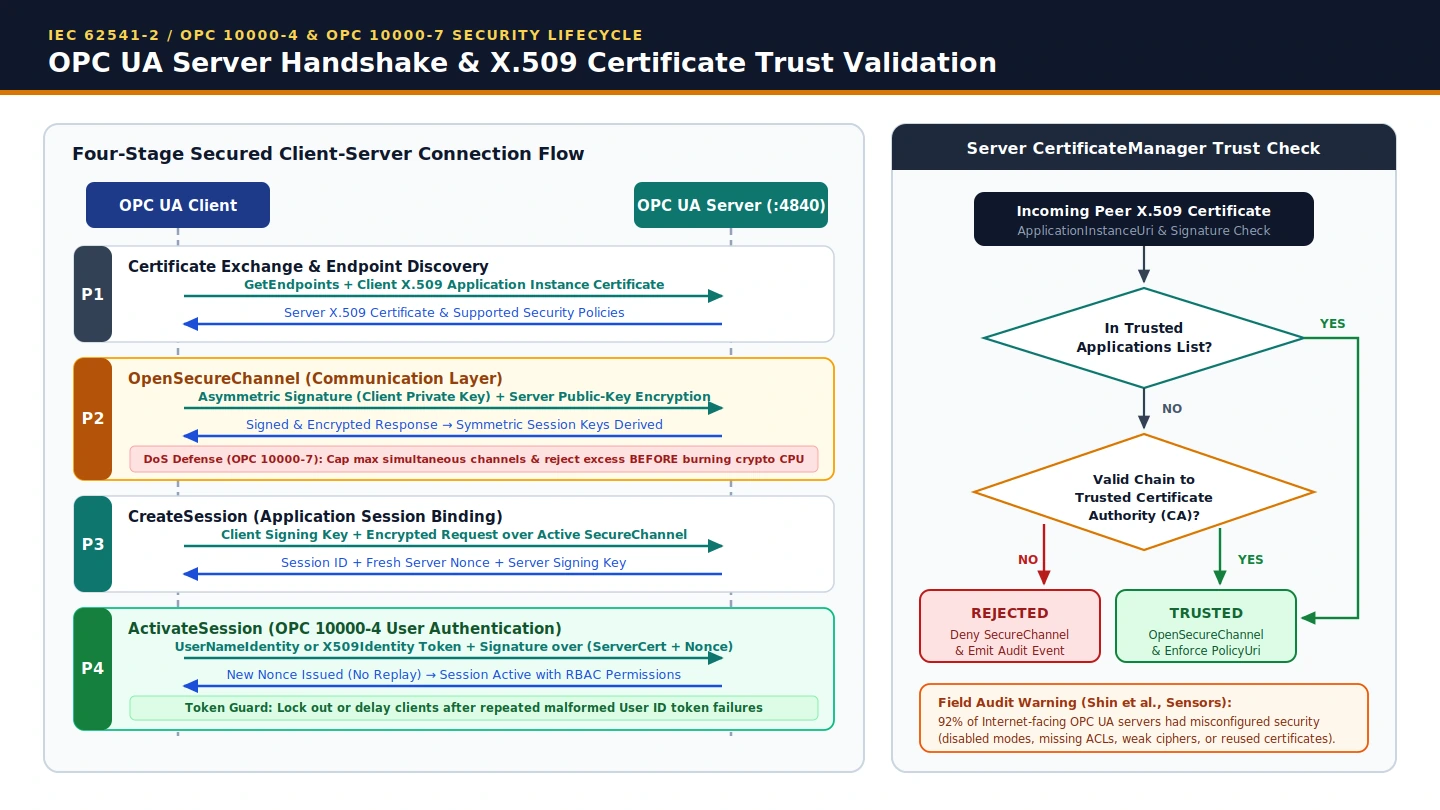
Three-Layer Security Model and Four-Stage Handshake
The OPC UA security model maps directly to the confidentiality, integrity, and availability (CIA) triad and the authentication, authorization, and accounting (AAA) framework:
- Transport layer: Firewalls and IP address rules filter unauthorized network peers before application traffic reaches port 4840.
- Communication layer: Negotiates a SecureChannel using asymmetric cryptography during key exchange and symmetric encryption and signing for ongoing messages (UA Secure Conversation for binary transport), defined by security policy parameters including PolicyUri, MinAsymmetricKeyLength, MaxAsymmetricKeyLength, DerivedSignatureKeyLength, and SecureChannelNonceLength.
- Application layer: Enforces X.509 application certificates bound to a developer-selected certificate store (such as a local PKI or Active Directory PKI), verifies user credentials (UserNameIdentity or X509Identity), restricts address-space views via role-based access control, and emits security audit events.
Establishing an authenticated connection follows four ordered processes: P1 exchanges application certificates and endpoints; P2 runs OpenSecureChannel, where client and server sign with their private keys and encrypt with the peer public key to establish symmetric session keys; P3 runs CreateSession over that SecureChannel; and P4 executes ActivateSession to bind a user authentication token. Under OPC 10000-4 session activation rules, the server generates a fresh nonce on every ActivateSession call so old nonces cannot be replayed, verifies that the calling client owns the certificate used during session creation, and rejects activation attempts arriving on an unrelated SecureChannel.
Trust Lists, the 92% Misconfiguration Reality, and DoS Hardening
Germany’s Federal Office for Information Security (BSI) evaluated OPC UA across four test disciplines—certificate testing, static code analysis, fuzzing, and dynamic code analysis—and confirmed that the specification offers strong protocol-level security with no systematic specification errors. In practice, however, message signing and encryption are optional because cryptographic operations add CPU overhead. An empirical survey cited by OPC UA IIoT vulnerability research found that 92% of Internet-connected OPC UA servers had misconfigured security settings, including disabled security modes, missing access controls, weak encryption, or reused certificates.
To close both impersonation and denial-of-service gaps on production servers, engineers enforce three concrete controls:
- Strict CertificateManager trust lists: Require every client certificate either to appear explicitly in the server’s trusted applications list or to rebuild an intact chain of trust to a trusted Certificate Authority, blocking rogue client impersonation.
- OpenSecureChannel DoS throttling (OPC 10000-7): Because asymmetric signing and encryption during OpenSecureChannel consume substantial CPU, servers defend against flooding attacks by delaying abusive request bursts, raising administrator alarms, and enforcing a maximum simultaneous channel cap that rejects excess requests without spending cryptographic CPU cycles.
- User token brute-force protection: When repeated malformed UserNameIdentity or X509Identity tokens fail validation during ActivateSession, lock out the offending client temporarily or introduce progressive response delays.
When Should You Use an Embedded PLC OPC UA Server vs. an External Gateway Server?
Choose an embedded PLC OPC UA server when only one or two local clients subscribe to a modest tag set on a modern controller, and switch to an external aggregating gateway server whenever multiple SCADA, historian, MES, or web clients poll concurrently or when legacy fieldbuses must be bridged. Direct multi-client fan-out multiplies stateful TCP sessions and memory queues on constrained hardware, degrading update intervals exponentially and risking thermal overload.
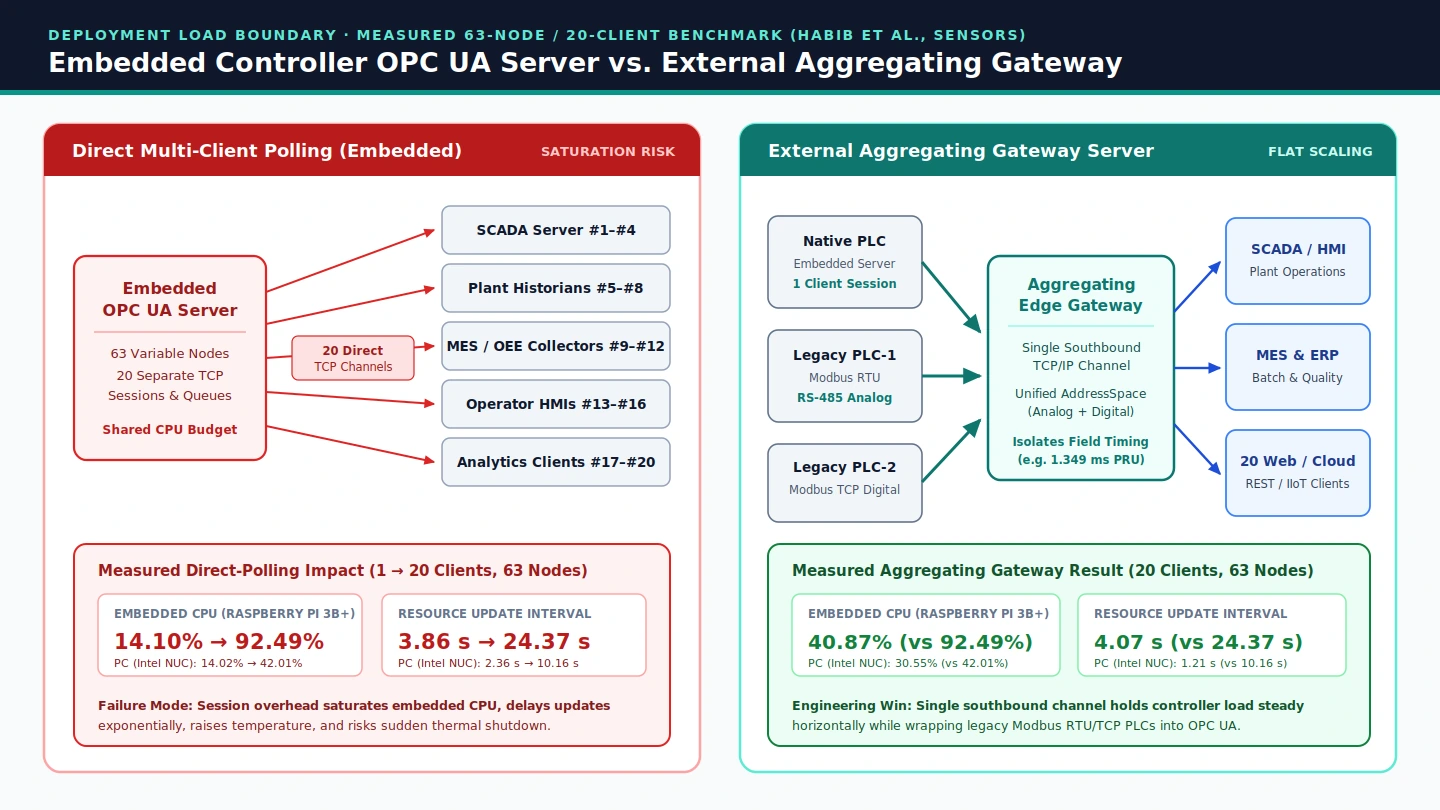
Measured Multi-Client Scaling: Direct Server vs. Aggregating Gateway
While ultra-minimal OPC UA servers have been demonstrated at chip scale—down to 15 kB RAM and 10 kB ROM by Fraunhofer IOSB-INA and inIT in October 2012, and on a 64 kB RAM single-chip ARM microcontroller by Embedded Labs Ltd—production multi-client workloads rapidly expose hardware limits. In controlled benchmarks published in aggregated OPC UA middleware research comparing a Windows Intel NUC PC (2.4 GHz Core i3 dual-core, 4 GB DDR4 RAM) against a Linux Raspberry Pi 3B+ (1.4 GHz quad-core 64-bit, 1 GB SRAM) across 63 AddressSpace variable nodes (with encryption disabled to isolate session load), scaling from 1 to 20 direct OPC UA clients produced a sharp divergence:
| Benchmark Metric (63 AddressSpace Nodes) | Intel NUC PC (1 Client) | Intel NUC PC (20 Direct Clients) | Intel NUC PC (20 Clients via Aggregating Middleware) | Raspberry Pi 3B+ (1 Client) | Raspberry Pi 3B+ (20 Direct Clients) | Raspberry Pi 3B+ (20 Clients via Aggregating Middleware) |
|---|---|---|---|---|---|---|
| Average platform CPU utilization | 14.02% | 42.01% (+28% delta) | 30.55% (+4% delta) | 14.10% | 92.49% (+78.38% delta) | 40.87% (+7% delta) |
| Server resource update interval | 2.36 s | 10.16 s (+7.78 s) | 1.21 s | 3.86 s | 24.37 s (+20.51 s) | 4.07 s |
| Network bandwidth (direct OPC UA) | 0.6996 MB/s | 4.9185 MB/s (7.8% of link) | Single southbound channel | 0.6662 MB/s | 1.4968 MB/s (1.7% of link) | Single southbound channel |
On the resource-constrained Raspberry Pi 3B+, managing 20 individual TCP/IP OPC UA sessions pushed CPU usage to 92.49%, drove update latency exponentially to 24.37 s, elevated CPU temperature steadily under continuous operation, and triggered unexpected thermal shutdowns in sustained runs. Placing an aggregating gateway in front of the server—acting as a single OPC UA client over one TCP/IP session while fanning data out to 20 upstream consumers—cut CPU consumption to 40.87% on the Pi 3B+ and 30.55% on the Intel NUC, holding resource update times flat at 4.07 s and 1.21 s.
Real-Time Acquisition Cycle Isolation and Legacy PLC Wrapping
Hard real-time fieldbus scanning imposes a second boundary on embedded OPC UA servers. As shown in Sitara AM335x IIoT gateway research, ARM Cortex M4 and M7 microcontrollers lack enough resources to host a high-performance OPC UA server and client alongside deterministic I/O. Splitting the workload onto a dual-domain SoC—specifically a Sitara AM335x pairing a 32-bit 1 GHz ARM Cortex A8 Linux core running an open62541 OPC UA server with two 32-bit 200 MHz Programmable Real-Time Unit (PRU) cores—kept a 10-slot fieldbus acquisition cycle running deterministically in 1.349 ms at 12 Mb/s (53.3% useful payload) while isolating Ethernet and operating-system latency on the upper Linux core.
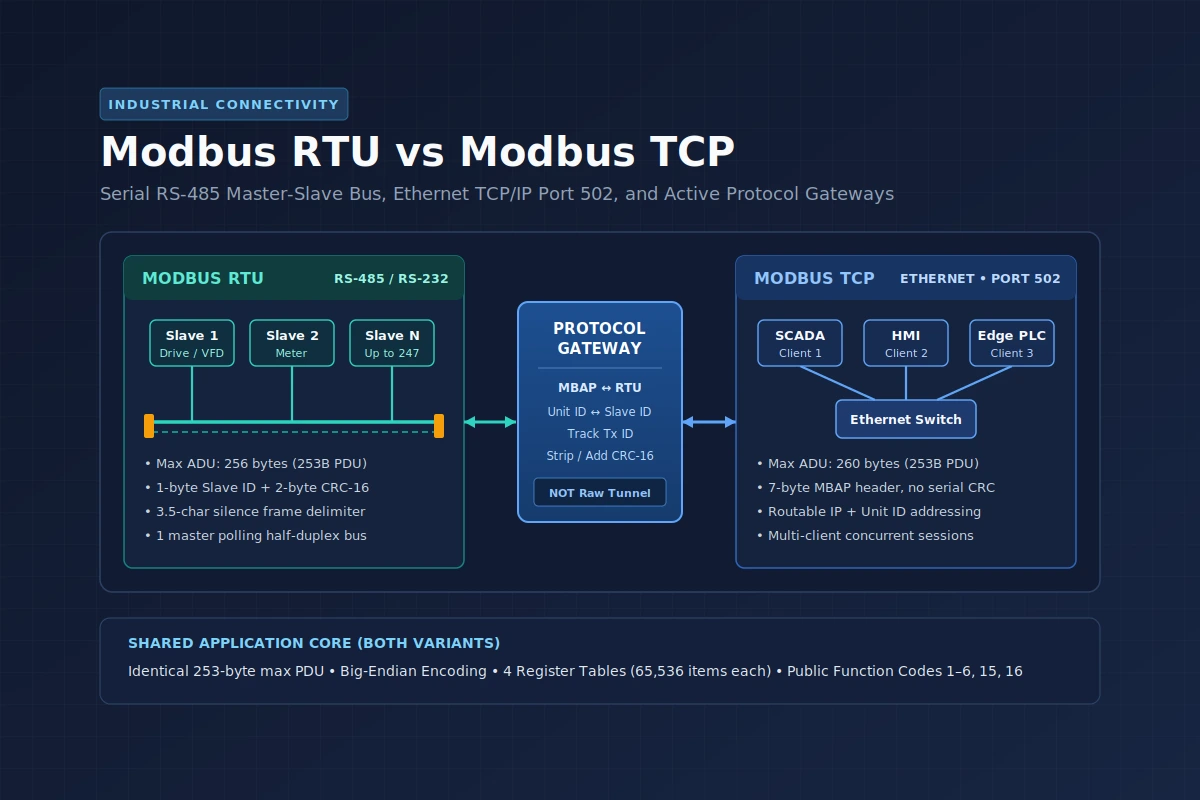
An external gateway server also solves brownfield heterogeneity on packaging and factory lines. In the same aggregated OPC UA evaluation, two Delta DVP-12SE PLCs without native OPC UA—one connected via RS-485 Modbus RTU for analog modules and one via Ethernet Modbus TCP for discrete I/O—were bridged into a single external OPC UA server exposing structured Analog and Digital Object nodes under one discoverable endpoint URI. When field links carry legacy serial registers, pairing a protocol gateway with Modbus RTU vs Modbus TCP framing discipline and industrial edge gateway store-and-forward buffering prevents both PLC overload and outage data loss.
Is an OPC UA Server Free or Licensed, and When Should You Use a Simulator?
The IEC 62541 specification itself is freely available from the OPC Foundation, and mature open-source OPC UA server stacks allow custom gateway and embedded development without per-seat license fees, while commercial SDKs and vendor-integrated PLC or SCADA servers carry proprietary licensing and formal certification options. Before connecting any licensed or open-source server to live production machinery, engineers validate endpoints, browsing, and subscription behavior offline using an OPC UA server simulator.
Open-Source vs. Commercial OPC UA Server Software
Open-source reference implementations are freely available to OPC Foundation members and under the GPL 2.0 license for non-members. For embedded Linux gateways, custom adapters, and standalone aggregation servers, several widely deployed open-source stacks provide full Client-Server support—including UA-TCP UA-Binary transport, Discovery, Browse, Read, Write, Methods, and Subscriptions—alongside commercial proprietary SDKs (in C, C++, Java, and .NET) and vendor platforms such as Siemens SIMATIC WinCC, Takebishi DeviceXPlorer, and NI LabVIEW:
| OPC UA Protocol Stack | Language | License | Documented Role and Characteristics |
|---|---|---|---|
| Open62541 | C | MPLv2.0 | Lightweight full-stack Client and Server implementation ported to Linux and Windows gateways with low CPU demand |
| Eclipse Milo | Java | Eclipse | Pure-Java open-source implementation supporting the OPC UA 1.05 Client and Server specification on Linux and Windows |
| Node-Opc-Ua | JavaScript | MIT | Cross-platform Client and Server stack supporting Linux, macOS, and Windows including NodeSet2 XML initialization |
| FreeOpcUa | C++ and Python | LGPL | Multi-threaded Client and Server libraries flexible enough for embedded Linux boards such as Raspberry Pi |
| OPC UA .NET | C# | RCL and MIT | Windows-focused stack supporting UA-TCP Binary, HTTPS, and X.509 certificate authentication |
Pre-Commissioning Validation with OPC UA Server Simulators
Using an OPC UA server simulator during bench engineering eliminates downtime risk while SCADA screens, historians, and gateway adapters are still under development. Free and open-source OPC UA server simulators from Prosys, Integration Objects, Matrikon OPC, and Unified Automation expose discoverable endpoint URIs and simulate live plant telemetry offline.
For example, the Prosys OPC UA Simulation Server publishes an Object class populated with synthetic variable nodes—counter, random, sawtooth, sinusoid, square, and triangle waveforms—allowing teams to test cross-platform clients such as UaExpert or custom middleware, verify NodeId browsing and NodeSet2 XML schemas, and exercise X.509 certificate trust lists before ever pointing a client at a running PLC.
What Should You Verify Before Commissioning an OPC UA Server?
Before placing an embedded PLC OPC UA server or an external aggregating gateway into production, verify six concrete architectural and security controls:
- Confirm transport endpoint and single-port firewall rules: Verify the server listens on its assigned UA Binary endpoint URI (default TCP port 4840) and block unnecessary inbound traffic at the Transport firewall layer.
- Audit AddressSpace NodeSet2 models and NodeIds: Confirm that required Companion Specifications and custom NodeSet2 XML files load cleanly, Object containers link DataVariables via HasComponent and metadata via HasProperty, and clients reference stable NodeIds and namespace indices.
- Disable insecure endpoints and enforce X.509 trust lists: Avoid the 92% misconfiguration pattern by disabling unauthenticated modes, configuring a strong security policy PolicyUri with signing and encryption, and approving client certificates explicitly in the CertificateManager trusted applications list or trusted CA store.
- Enforce OpenSecureChannel and ActivateSession DoS guards: Configure maximum simultaneous channel limits per OPC 10000-7 so excess OpenSecureChannel requests are rejected without performing signing or encryption. Enable client lockout or response delay after repeated malformed UserNameIdentity or X509Identity token failures during ActivateSession per OPC 10000-4.
- Cap direct client fan-out on embedded controllers: Route multiple SCADA, historian, MES, and web consumers through an external aggregating gateway server holding a single southbound session whenever embedded hardware or deterministic fieldbus scan cycles are shared.
- Run offline validation against an OPC UA server simulator: Exercise client discovery, AddressSpace browsing, certificate trust exchanges, and sustained subscription load against a simulator such as Prosys or Unified Automation before cutting over to live plant PLCs.